Tuesday, January 31, 2012

Buffalo Soldiers

So there's this guy.

He's from Texas.

We're dating.

He lived in Mammoth for a season or two, and had to fend for himself while he was there. Poor thing. Anyway, he told me he used to make buffalo tacos when he lived there, and that he'd sing "Buffalo Tacos" to the tune of "Buffalo Soldiers" by Bob Marley. I think he even sang a verse for me to demonstrate. I didn't think much of any part of this story at the time, since it was a) less gory than the one about hunting and gutting his own venison; b) an affront to reggae lovers everywhere; c) probably just something Texans do.

One evening, we decided to cook dinner together at my house. You know, one of those couple-y things that people do together when they are still so enamored of each other that they can't get enough, so they plan the meal together, cook it together, eat it together, talk about how great it was together, and suddenly realize that 48 hours have gone by and they are still in each other's company.

He said, "Let's make buffalo tacos, like I used to make in Mammoth! I'll bring the meat."

Because that's what men do.


No, this wasn't the last remaining wild bison roaming the Great Plains.


I was a little wary of this whole idea. I'd seen bison burgers in the freezer case at the grocery store, as well as bison stew meat. But I'd never tried it, and wasn't sure how gamey it would taste. The Texan assured me buffalo meat was not very gamey, and would render off less fat than ground beef. Given that he has eaten deer shortly after killing it, I wasn't sure how closely aligned his version of gamey was to that of Normal People. But it turns out he was telling the truth.

Neither one of us had a real recipe for buffalo tacos. He usually used one of those seasoning packets, which he suggested and I must have made a face about, since he didn't bring one. I usually used a few spices in the meat, which I added as he stirred**, but it was missing something. A jar of salsa sat on the counter, and we both agreed it was worth a try. We added a few spoonfuls to the meat, which we thought tasted perfect.


His

Hers


He heated up the tortillas. He put cheese and more salsa on his. I put cilantro, radishes, lettuce, green onions, and more salsa on mine. We sat, googly-eyed, at the table together and ate.

We'll have to do it again some time.


**Despite me putting the real version of that song on the iPod, he sang his version almost the entire time he was cooking the buffalo. Guess which version was stuck in my head the next day.

Friday, January 6, 2012

The Sweet Texture of Success


I've lost track of how many times I failed at this. I blogged about it. I searched endlessly for the perfect recipe. I bought a new thermometer. I asked questions of other bloggers who are clearly more skilled than I. And still, I couldn't get it right.

I was nearly ready to give up trying, but then another blogger was generous enough to give suggestions and wish me luck, and an old friend went on a hunt for a digital thermometer for me.  Back at home, she hovered over the thermometer with me while we held our breath, hoping the 27th time would be the charm. And it was.

I realize people have been making caramel for centuries without the aid of digital anything. I realize I probably didn't angle the analog thermometer into the mixture properly, or may not have read it carefully, as the lines and numbers are small and the margin for error is even smaller. But I don't really care, because I can make caramel now.


I said I CAN MAKE CARAMEL NOW! How exciting is THAT?


So what if the whole world knows I have to use a digital thermometer? To borrow a friend's explanation for anything complicated, "It's science." I've seen videos of master chocolatiers who use digital  sensors that don't get dipped into the chocolate, but instead are just aimed toward the chocolate and instantly read its  temperature. Now that, my friends, really is science.

It's not dirt! It's flecks of vanilla.


Eleven more degrees to go.

 The thermometer even beeps at me to tell me I'm almost there. Isn't she nice?


Many thanks to Shawnda of Confections of a Foodie Bride for her advice and encouragement!

All Threats Will Be Taken Seriously

My dad threatened my brothers and me this year.

His side of the family has been making stuffed calamari on Christmas Eve for as long as any of us can remember. The still-living relatives who know the recipe are four in number: two of his sisters and one brother on the East Coast, and my dad on the West Coast. The still-living relatives who will eat the dish are similarly few in number: one of my sisters-in-law, a few cousins, an old friend of my brother, and I. Even so, my dad's threat to stop making the dish after this year created quite a stir.


Here’s what you have to understand about traditions. They have nothing to do with the finished product. They are really about the stories that get told about them. For example:

(back of hand pressed to forehead) “I worked my fingers to the bone to make this calamari/sauce/appetizer/ravioli for you!” 


As the photo clearly indicates, my dad had help this year (and nearly every year I can remember) making the calamari, but it wouldn’t taste the same without his one-sentence guilt trip. And as with all great traditions, this is one that was passed from his parents to him and his siblings, and then to us, and I am certain at least one of my brothers will use it on his children just as soon as they are able to internalize guilt. 

Traditions, though, eventually become forgotten if no evidence of them exists. Stories told and retold help prolong their life, but these are not immortal. My small nieces, nephews, and second cousins simply won't be able to grasp just how fishy the marinara sauce becomes with the squid in it, or how tedious it really is to stuff the calamari, or how whiny the pitch of the voice should become when laying the guilt on nice and thick if they never witness The Stuffing Of The Calamari. All of these, and the conversations they spark (which are nearly identical year after year), are what make Christmas Eve the production it is in my family. 

So when my brother informed me that our father threatened to remove this critical element from the celebration, I devised a 21st century fix: blog about the recipe, and preserve it for the 2.87 people who still want to make it. 

With camera and notepad in hand, I arrived at my brother's house and got to work. Note that cute cupcake aprons are vital to the whole operation. My dad had already done the gross important work of beheading and disemboweling the squid (when imparting guilt, always use words such as 'disemboweling' instead of 'cleaning' for dramatic effect). He had also prepared the stuffing, so all that was left was to stuff the squid,


seal them closed with a toothpick, 

Warn your guests that there are toothpicks in the food BEFORE they eat it.


and cook them in the red sauce that was simmering on the stove.


Except it's never that simple. There's always the running commentary that goes along with any labor-intensive meal preparation. This year, the fatherly lecture was on the size of the calamari: the neck openings were practically microscopic, which made them hard to stuff efficiently, which prompted the obligatory Back In My Day monologue. As in,

"Back in my day, the fishermen would've thrown squid this small right back into the water! Bah! Can you believe it? This is all a result of overfishing, you know. These blasted gigantic fishing operations will just take anything nowadays, won't they? Anything for a profit, I tell you. The whole world is going to hell in a handbasket..."

Yep, plenty of Christmas cheer at our house.

Then there were the lucky few who asked about the origins of the recipe: some of our secret family recipes contain bits of dried fruit, especially raisins, which is a typical North African influence. Our calamari stuffing is no exception, so the inquirers listened attentively at first to the explanation, and before long their eyes glazed over as they were subjected to the Unabridged History Of The Arab Influence On The People Of Southern Italy And The Ancestry Of The DiStasi Family Which Might Be Descended Partly From Albanians.

But in the end, it is these stories of tradition that have such powerful influence over us. Their demise, real or only threatened, can spark reconciliations, my brother eating stuffed calamari for the first time in forty years, or possibly even a sudden interest in migratory patterns of people along the Mediterranean Sea. And of course, there is the next generation of the family that has begun its years-long initiation into the realm of Stuffed Calamari. The tradition may live on after all.


NB: An ongoing debate in our family is on the merits of cooking the calamari in the marinara sauce, as opposed to boiling them and spooning sauce over them. Cooking them in the sauce makes the sauce fishy, which is why the small children pictured above are actually eating pre-fishified sauce that was set aside just for them. The next day, the sauce reeks of fish, making it unappetizing to most of us, while the elders of the family stand around scratching their heads, wondering why no one has eaten the leftover pasta with (fishy) sauce. Cook the squid as you see fit.

Stuffed Calamari
In true Old World style, the amounts are approximate, and each cook adds quantities to his liking. The goal is to achieve a stuffing that is moist but not wet, with a balance of herbs, salt, and sweetness from the fruit and nuts.  
5 pounds fed a crowd of 10 adults, plus extra for me to bring to a friend, plus a few left over for the next day.
5 lbs squid, thawed (if purchased frozen), gutted, and cleaned
3 slices slightly stale wheat bread
1/3 loaf slightly stale sourdough bread (approximately)
1/3 to 1/2 C bread crumbs
handful of raisins (or more, if you like)
handful of pine nuts (or more, if you like)
some parsley, chopped
a little basil, dried
a few cloves of garlic, minced
1/4 C grated parmesan cheese, more or less
2-3 TBSP marinara sauce that the squid will be cooked in
salt and pepper to taste

1. Tear breads into small pieces, and toss in a large mixing bowl. Add bread crumbs and remaining ingredients EXCEPT marinara sauce. Mix well.
2. Add marinara sauce (use a bit more if mixture is very dry). Mix well. 
3. Stuff calamari, leaving enough space at the open end to insert toothpick to close (see photo above). Be careful not to over-stuff squid, as they tend to burst while cooking. 
4. Cooking time depends on quantity of squid in pot, but will generally be between 3-5 minutes after the sauce or water has returned to a boil once squid are added. Squid will turn cream-colored when done. 
5. Drain immediately and serve with marinara sauce, alone or with pasta.


Wednesday, December 14, 2011

Fifteen Days


It took me 15 days to make this bread.

Sort of.

It took me 15 days to make the sourdough starter that became this bread. 15 days of feedings, of worrying that it might not survive, of wondering what kind of character it would develop. That's right. It became my child for two weeks.


Clearly I'd make a horrible mother, since I forgot to feed it on schedule once or thrice.  This is why I haven't reproduced. Anyway. My child turned out just fine, of course, getting stronger and less smelly over time. Its first two loaves were not great, tasting a lot like something that was baked in a Fisher-Price oven, but then came the third loaf. Pretty near perfect, and I'm not just saying that because I'm its mother.

In Breads from the La Brea Bakery, Nancy Silverton makes a simple statement that makes everything about bread baking infinitely more complicated: Bread is alive.  The starter used to make it is born of wild yeasts and beneficial bacteria in the air. The starter has a metabolism, which is maintained through portion control and eating regular meals.  It is temperamental and likes the room to be at a balmy 75 degrees. And it can be ornery-- it will be ready to bake when it is ready to bake, and not before.

It reminds me of someone I know.

I can't think of who it--

Oh right. Me.


The answer to your question is, "Because it tastes better." Commercial (i.e. active dry yeast that you buy at the grocery store) yeast makes the dough rise too quickly, like it's taking growth hormones or something.  The flavor and character that are found in good loaves of sourdough bread come from the yeasts in the starter, and from the slow rise that happens as the starter is chomping on the starch in the flour. Silverton even says that starter created in New York, for example, won't have the same flavor as starter created here in the Bay Area, because the yeast varieties are different in the two regions.

It's like East Coast vs. West Coast rap, only with yeast.

I passed a bakery in Chicago once that offered baking classes. I stopped in to talk to the owner, who was a large, pasty, sweaty hulk of a man with a thick Eastern European accent. He was (a little too) excited to show me his starter, which was also large, pasty, and sweaty-looking, and I really didn't understand its purpose or his enthusiasm for this stinky glob. He said he drank some of the liquid daily for health, to which I silently replied that it clearly wasn't working.

I didn't take the classes from him.

But I do understand now why he was so excited about his starter, and why his having kept it alive for years is really quite impressive.  I so should have taken his classes.

Raising and maintaining a starter is fairly easy, now that I've got the hang of it. I have a container of base starter that lies dormant in the refrigerator until I need it. I now use a sticky note on the lid of the container to keep track of feedings, and I start with a smaller quantity each time I want to bake, since

1 cup starter + [(1 cup water + 1 cup flour) x 3 times per day x 3 days] = enough starter to fill a swimming pool


As with all living things, though, the starter must go through the cycle of life.  It is cute and bubbly as a child, then toughens a bit as it rises, and later takes on a distinct shape and size as it prepares for the oven. But as it bakes, the starter dies-- it is 450 degrees in there, after all-- and leaves behind its legacy in the form of a loaf with a crusty exterior, a chewy and irregular interior, and a note of pleasant sour.

Fortunately, its starter relatives are still alive in the fridge, and so it begins again.


Monday, November 28, 2011

Sugar, Sugar

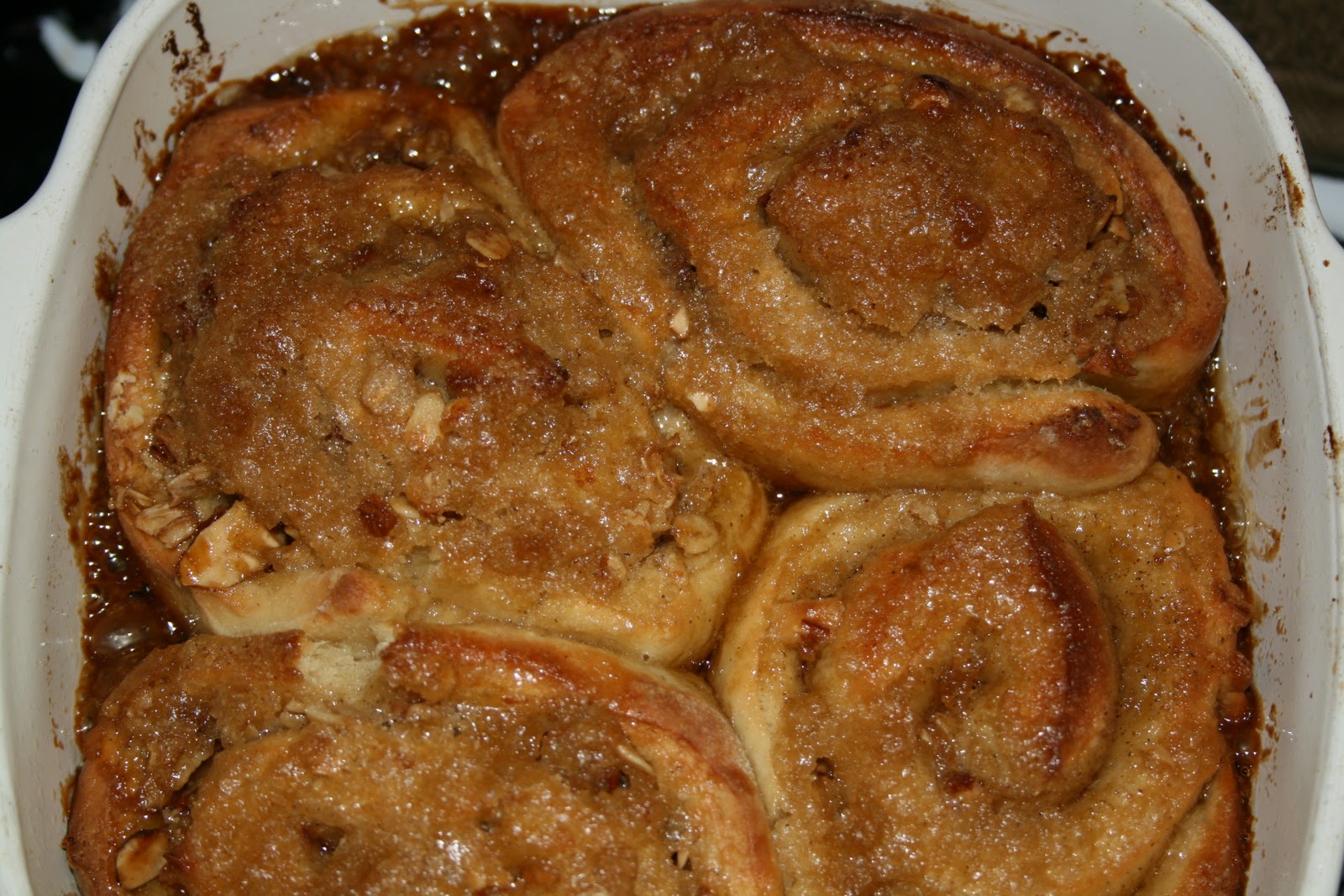
Version 1, with syrup on bottom.
Because I didn't stuff myself quite silly enough over Thanksgiving weekend, I made these as soon as all the pumpkin pie was gone.


When I was a teenager, my mother subscribed to Center for Science in the Public Interest's monthly magazine, which ran exposés on all the artery-clogging restaurant foods in existence. One of which were Cinnabons, which in my opinion are the best non-food food at the mall. Not that I ever eat them. Or go to malls. That's just what I've heard.

One of the obscure flours I mentioned in an earlier post that has been waiting to be used is oat flour. I found a recipe for Double Oat Morning Buns, which I hoped would be like cinnamon rolls. Or snails. Or Cinnabons. Except with cardamom. And because I found the recipe on the Bob's Red Mill website, I figured it'd be relatively healthy, if not downright dull.

I figured wrong.

I realized my wrongness as I started Step 1, which is to combine just three ingredients for the sticky mixture that gets caramelized all over the place. The ingredients were sugar, maple syrup, and butter.  Delicious, for sure. But not even a little bit healthy.

Then in Step 2 I figured I'd even out the butter-sugar chaos with some fiber-licious oat flour. I did, but I also had to add more butter, more sugar, some eggs, and a cup of milk.  Which has calcium and protein and whatnot, but still.

Step 4 brought-- yes, that's right-- more sugar. Oh, and a tiny bit of rolled oats to up the fiber count. And cardamom. I love cardamom. If you don't, you can substitute cinnamon, with maybe a little allspice or cloves.

I started this recipe last night, because I knew the dough needed to be refrigerated for a bit, and I thought popping these in the oven first thing in the morning would be just like a Folger's commercial, only with baked goods. There is a non-refrigeration option, so I put the odds and ends of the dough in the oven last night with a little of the sugar-syrup mix on the bottom of the pan, as directed. But the buns I got were dry on top, and could have used more butter after baking. Furthermore, the sugary mix on the bottom got all overcooked and one corner of it almost burned. No good.

This morning, I decided to put the sugar mix on top of the buns and bake, letting it all run down the sides. You know, like at Cinnabon, but without the cream cheese icing. This did the trick-- soft, almost spongy dough, texture from the almond-oat-cardamom filling, and sweetness from the syrupy mess on top. All this amounts to the perfect way to start the day: in cardiac arrest. Just like at Cinnabon.

Version 2, with syrup running down the sides


Double Oat Morning Buns
adapted from www.bobsredmill.com
makes 18 buns-- cut recipe in half if you can't use that many

For the sugar mixture:
1/2 C maple syrup
1/3 C packed brown sugar
1/4 C butter

For the dough:
1 TBSP active dry yeast
1 C oat flour
3 to 3 1/2 C AP flour
1 C milk
1/4 C granulated sugar
1/4 C butter
1 tsp salt
2 eggs
2 TBSP butter, melted

For the filling:
1/3 C almonds, toasted and chopped
1/4 C packed brown sugar (you can probably use about half this much and get good results)
1/4 C rolled oats, toasted (you could double this amount for more texture)
1/4 tsp cardamom (I used 3/4 tsp)
1 TBSP butter, melted

I've changed the order of the steps, because the sugar mixture doesn't need to be made until just before these go in the oven. However, it can be made ahead and kept at room temperature until needed. 
1. Combine 2 cups of AP flour and yeast in the bowl of a stand mixer.
2. Combine milk, granulated sugar, 1/4 C butter, and salt in a saucepan over low heat until just warm and butter is melted (115-120 degrees F).  Add to flour mixture, and stir to combine. Add eggs. Beat at low speed for 30 seconds, and then scrape down sides of bowl. Beat 3 minutes at medium-high speed. Using a spoon, stir in the oat flour and as much of the remaining AP flour as you can. Turn dough out onto lightly floured work surface.
3. Knead in enough of the remaining AP flour to make a moderately stiff dough that is smooth and elastic (6-8 minutes, total). Place in a lightly greased bowl, turning once to coat. Cover and let rise in a warm place until doubled in size (1 to 1 1/4 hours).
4. Combine filling ingredients EXCEPT butter in a small bowl. Coat a 13" x 9" x 2" baking pan with cooking spray.
4. Punch down dough and divide in half. Cover dough and let it rest for 10 minutes. On lightly floured work surface, roll one half of dough into 9" x 6" rectangle. Brush top with melted butter.  Sprinkle half of filling mixture over melted butter on dough. Roll up jelly-roll style. Cut into 1-inch rounds and place cut side down in prepared pan. Repeat with remaining half.
5. Cover with plastic wrap and refrigerate at least 2 hours, or overnight.
6. Preheat oven to 375 degrees F. Remove buns from refrigerator and let stand at room temperature for 20 minutes. If any surface bubbles have formed, puncture with greased toothpick. Combine mixture ingredients in a saucepan, and stir over low heat until butter is melted and sugar is dissolved. DO NOT BOIL. Coat tops of buns evenly with mixture. Bake for 20-25 minutes. Cool slightly before serving.

Wednesday, November 16, 2011

Woman, where's my dinner?

Many years ago, I dated a man from a rather, um, patriarchal culture. He expected a meat-centric dinner, piping hot, whenever he stayed at my house. Note I didn't say he helped me prepare a meat-centric dinner.

My cooking skills were still under development at that time. (In truth they always will be, but they have improved tremendously.) I knew which flavors I liked, and which ingredients I was willing and able to use, but didn't always have technique perfected, nor did I have much patience for dishes that needed to simmer for hours on end. Those simmery dishes, though, are the ones that are usually filled with meaty bits and starchy bits, good for filling this man's professional-athlete appetite and quieting his inquiries as to the status of his next meal.

I remembered my mother making beef stew many times, which she usually served over egg noodles. She also used the terms 'beef stew' and 'bouef bourguignon' interchangeably, at least as far as my adolescent ears could tell. I knew she put some wine into the dish, and carrots and maybe celery, but I didn't know how to make it, exactly. Or if there were some small but important distinction to be made between stew and bourguignon, besides that Julia Child made the latter and we Irish made the former.

Determined to show his chauvinistic self I could do it, I called my best friend and begged her to tell me what to do. I knew she'd know, since she'd had more than one live-in boyfriend and was adept at cooking for them.  She told me to cook it for a while, which I thought I did, but apparently not long enough. It never came out quite right, and the wine flavor was never quite tame enough. He always gave me his full, unabridged critique.

Years (and relationships) later, I have finally learned to be patient with meat. I cook my stews long enough to create depth of flavor, and really tender meat. But I hadn't made a real bouef bourguignon until now. Julia Child made it famous, but Ina Garten made it simple: Barefoot in Paris contains a recipe with an introductory note specifically saying how un-fun it is to cook this dish all day long. To which I say, Amen, sister!


I leave the skin on the potatoes for a bit of added color and texture.


I was skeptical about using two different kinds of meat in one dish. To me, that always seems like flavor confusion, since each meat (e.g. beef, pork, chicken) has its own unique flavor. Well, maybe not chicken, since everything tastes like chicken, but beef and pork certainly do. Nevertheless, I seared the beef in the bacon drippings, as directed, and then coated the vegetables with all that fat and a few herbs, too. The wine went in early on, and combined with some broth and a little roux at the end to create a rich, flavorful gravy that could stand alone over mashed potatoes. 

Ina Garten suggests serving the dish with some country bread that has been toasted and spread with a bit of olive oil and garlic. My neighbor just happened to make a loaf the same night I made bouef bourguignon, so I ate it with both bread and mashed potatoes. I'm sure Julia Child and the entire nation of France would be horrified, but if ever there were a bowl full of Man Food, this is it.


Mia's cooking: 1, Patriarchy: 0


Bouef Bourguignon
adapted from Barefoot in Paris by Ina Garten

**I started with 1/2 lb beef and 1/3 bottle wine, and adjusted the rest of the ingredients accordingly, since I made this for myself and not for the entire Russian army. I also cooked mine on the stovetop, not in the oven, since I don't have a Dutch oven.

1 TBSP olive oil (I omitted this, since the bacon will render off plenty of fat)
8 oz bacon, diced (I used applewood-smoked bacon)
2 1/2 lbs beef stew meat
1 lb carrots, sliced diagonally into 1-inch chunks 
2 yellow onions, sliced
2 cloves garlic, chopped
1/2 C Cognac or brandy (I omitted this)
1 (750mL) bottle dry red wine
2  to 2 1/2 C canned beef broth (I used low-sodium vegetable broth)
1 TBSP tomato paste
1 tsp fresh thyme leaves (I used dried)
4 TBSP unsalted butter, at room temperature, divided
3 TBSP all-purpose flour
1 lb frozen small whole onions (I omitted these)
1 lb mushrooms, sliced (I omitted these)
Salt and pepper to taste

1. Preheat oven to 250 degrees, if using a Dutch oven.
2. Heat a Dutch oven or other large pot. Add bacon and cook over medium heat for 8-10 minutes, stirring occasionally, until the bacon is lightly browned. Remove bacon from pan with a slotted spoon and set aside. 
2. Sprinkle beef cubes with salt and pepper. In a single layer (work in batches if necessary), sear the beef in the bacon fat 3-5 minutes, until brown on all sides. Remove beef cubes from pan and set aside with bacon. 
3. Toss carrots, onions, some salt and pepper (I added thyme here too) into fat in pan and cook over medium heat 10-12 minutes, stirring occasionally, until onions are lightly browned. Add garlic and cook 1 minute more. Add Cognac if using, STAND BACK, and ignite with a match to burn off alcohol. Return meats to pan, along with juices from the plate. Add wine and enough broth to almost cover the meat. Add tomato paste and thyme, if not already added. Bring to a boil and either cover with lid and put in oven for about 75 minutes, or simmer over low heat for 75-90 minutes with cover just slightly askance. Meat and vegetables should be very tender when pierced with a fork.
4. Place the stew on the stove top, if not already there. Combine 2 TBSP butter and the flour with a fork and stir into the stew. Add frozen onions, if using. 
5. In a medium pan, saute the mushrooms, if using, in the remaining 2 TBSP butter over medium heat for 10 minutes, or until lightly browned, and then add to the stew. 
6. Bring the entire stew to a boil, then lower the heat and simmer, uncovered, for 15 minutes. Season to taste. 
Serve with sliced country bread rubbed with garlic, or mashed potatoes, or egg noodles.


Tuesday, November 1, 2011

#Occu-Pie


 "Occupy! Occupy! What kind of pie? Occupy!" 

 This catchy little chant has been stuck in my head for days. A man at a non-Occupy protest I attended last week kept shouting it during lulls in the action. As I listened, I was food-inspired. Though I wondered, What's in Occu-pie, anyway? 

Apples, of course. Apple pie is quintessentially American. So is the right to assemble, peacefully, and voice one's discontent with the status quo. I used three kinds of apples: Jonathan, Braeburn, and Granny Smith. Sort of like the apple version of a melting pot. 

But regular old apple pie wasn't enough to qualify as Occu-pie. It needed something more. Something slightly out of the ordinary, but not all hippie-like and beyond the mainstream. Maybe something with a little kick to it. 

Bourbon. For liquid courage (symbolic, of course, since the alcohol burns off) in the face of police throwing flash-bang grenades and tear gas, and maybe a little warmth on cold nights in tents. Having a non-existent hard liquor cabinet myself, I borrowed a few tablespoons from my neighbor. Who then borrowed some white wine I'd just opened for a recipe she was making. This sort-of-barter system suits us just fine, helping us ensure we use up what we have, saving us a few fossil-fuel-powered trips to the store, and creating a little mini-community of food and ideas that is the antidote to the Every Man for Himself attitude that fuels the Occupation.

Even though I made 25% more crust dough than I did for my Bolinas Blackberry Pie, I still didn't have enough to make a full lattice. So I threw flour, unmeasured, and butter at the wrong temperature into the food processor to make more. I chilled the dough, which I realized later was missing sugar, for one-fourth of the time I should have, and got a very pretty lattice that tasted like Play-Doh. This hasty fix for my pie was a gentle reminder that, like dough, change happens slowly.


While statements from protesters such as, "I have a Master's degree and I can't find a job" or "Big Banks foreclosed on my home" allow individuals to connect to the larger movement, #Occupy Wall Street isn't about getting those people's houses or jobs back. At least, not directly. It's really about changing a system that is totally out of balance, and is totally unsustainable. This MoveOn video, featuring Elizabeth Warren, sums it up nicely.