Showing posts with label dairy free. Show all posts

Wednesday, July 19, 2017

Panzanella

This might be my favorite summer lunch ever.

Tomatoes from the farmer's market. Leftover crusty bread. Really good balsamic vinegar and some olive oil. So. damn. good.

Yeah, it's peasant food. It's a way to use up stale bread bits that you might not use otherwise. It's also how you use up all those tomatoes from your garden. And basil, if you happen to grow it. And maybe a cucumber if you are going all out.

The quality of your balsamic matters here. Splurge on the good stuff, and skip the crap that has flavor and color added that you buy at the grocery store.  Bonus: the good stuff is ridiculous drizzled on your summer strawberries.


Summer Panzanella

Ingredients:
maybe half a loaf of some leftover crusty bread (ciabatta, baguette, sourdough, whatever)
a couple of ripe tomatoes (heirlooms are my favorite, but even little cherry tomatoes will work)
a shallot (or maybe 1/4 onion)
a small cucumber (optional)
a few basil leaves (optional)
a few TBSPs olive oil
a generous drizzle of balsamic vinegar
salt & pepper to taste

NOTE: Your bread may be very dry, or not so much. Your tomatoes will be super juicy, or not. These factors will determine how much olive oil and vinegar you need. Start with a little. Add more if needed. Don't drown your salad in oil. Just add enough to moisten the bread.

1. Cube bread and place in a medium bowl. My cubes are maybe 1" or 1.5" around.
2. Cut up tomatoes (and cucumbers, if using) into pieces a little smaller than your bread cubes. Add to bowl.
3. Slice or finely dice your shallot/onion, depending on how much raw shallot you can tolerate in each bite. Add to bowl.
4. Roughly chop basil and add to bowl. Or chiffonade if you are feeling fancy.
5. Add olive oil and balsamic, and S&P to taste. Toss and set aside to absorb liquid, 10-15 minutes. Toss again and serve.


Saturday, July 21, 2012

Taco Night

The Texan loves fish tacos. Like, to the point where I wouldn't be surprised if he up and moved to Baja and grew his hair all long and stringy and started wearing board shorts every day.

The first time he suggested we eat them, I wasn't altogether sure I'd like them, much less love them. I admit now that I do love them, but there are three problems with them.

1. Our favorite kind involves fried fish.

2. Fish is loaded with lead.

3. Many popular varieties of fish are overfished, or come from poorly managed fish farms.

On a weekend when the Texan happened to be out of town, my neighbor made fish tacos that offered a compromise to Problem Number 1. She breaded the fish filets in panko-style breadcrumbs, and then baked them in the oven. The breadcrumbs created the textural appeal of fried fish without all the fat and cholesterol. She sliced them into strips to serve, along with cabbage slaw, avocado slices, and lime quarters to squirt on top.

I liked them so much that I made them the next day for my dad, substituting shrimp for the white fish and adding a black bean-corn mixture to the fixings, as well as a little bit of jarred salsa. He seemed to like them, and they were ready in a ridiculously short time.

For a quick dinner before a date at the ballpark this week, I decided to make the fish tacos for the guy who loves them the most. I used shrimp again (I bought the 16-20 size, which I think is a little too big; in the future I'll use the next-smaller size), sauteeing it quickly in a little olive oil, salt and pepper, and a teensy bit of cayenne.

I couldn't remember exactly how my neighbor made the slaw, so I just sliced cabbage very thinly, added some cilantro, and then lemon juice, S & P, and an even teensier bit of cayenne. I think she added either yogurt or sour cream to hers, but I don't use dairy if I can avoid it.

I sauteed some green bell pepper with a bit of onion in some olive oil and S & P, sliced some avocado, and boiled an ear of corn, and put them in individual bowls to be used according to taste. I also had a ripe mango and some peaches just waiting to be used, so I diced those, added some cilantro, onion, lemon juice, S & P, and a teensy bit of cayenne to make a fruit salsa with a little kick.


The fruit salsa adds the perfect amount of moisture to the tacos, without becoming soggy and drippy.


He loved them. What surprised me the most was that he also loved the fruit salsa, because he is not the Number One Fan of either mango or peaches. Granted, I had just found his new favorite chip at Berkeley Bowl -- a blue corn-quinoa-chia-maca salt-free chip -- so he had reason to eat many of them, but he's perfectly happy eating the chips plain so he must have actually, like, liked it. 


The only way to deal with Problem Number 2 is to eat fish sparingly. This would put a definite cramp in the Texan's Baja style, but while we still live in northern California, this is Just The Way It Is.  And as for Problem Number 3, I screwed up this time around. Not only were the shrimp I bought too big, but they were wild-caught from Mexico, which, according to my Seafood Watch app, is not a well-managed source of seafood. Think tons, literally, of sea turtle and small fish bycatch. Had I bought the smaller ones, I would have purchased US farm-raised shrimp, which is one of the most sustainable options.   See what happens when I get all greedy?


Sunday, August 7, 2011

Meat n' Wheat Free

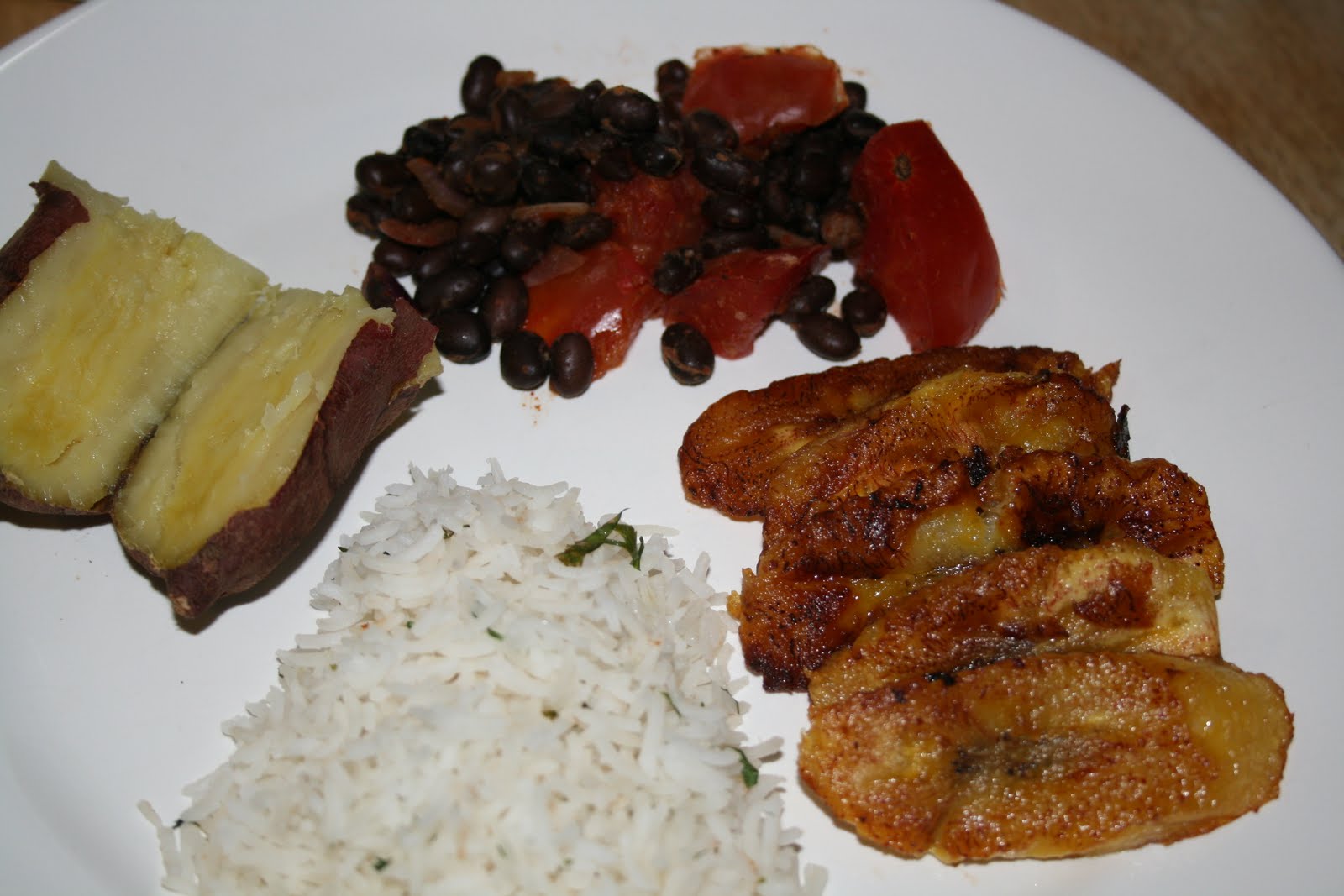
L to R: yams with skin on, platanos fritos, brown jasmine rice with tomatillo-avocado salsa, black beans with jerk, and dinosaur kale. This is a salad plate, not a dinner plate, and after eating everything on it, I am 100% full!


My friend RSJ is a vegetarian. She is also gluten intolerant. Her husband KJ, a carnivore who likes his ground beef nestled between two rounds of wheat, sums up her dietary needs this way: "So basically, you need a meal that is meat- n-wheat-free." Indeed.

I'm not a vegetarian. I'm not gluten intolerant. I don't spend a lot of time thinking up meals that would suit RSJ's needs, especially since we live in different time zones now. But I do eat a few meatless meals each week and have thrown together un plato of sorts that is inspired by some of my favorite cuisines. Best of all, it is free of meat, wheat, and dairy. You know, the  way the other 99% of the planet eats.

There are those who believe that eating a meal with no meat in it is an utter waste of the energy it takes to bring fork to mouth. To this I say, quinoa-barley-seaweed pilaf doesn't really satisfy me either. But when I create meals that are not vegetarian versions of dishes I love, but instead are just good vegetarian meals, I am almost always satisfied.

The July/August 2011 issue of Vegetarian Times features an article on the best veg food trucks across the nation. The mention of one truck's coconut-mashed yams caught my attention, since I firmly believe that everything is better with coconut. Then the plantains ripening on the counter popped into my head. The free association-- I do this a lot when I am cooking-- continued with the jerk seasoning I haven't put on chicken yet, the black beans waiting in the pantry, greens in the crisper, and cilantro growing on the fire escape to go in the rice I wanted to put next to the black beans. (Yeah, I've heard that you don't have to eat these two together to make a complete protein, but I still like the combination.)

The prep and cooking time for this plate is super-fast, making it a good choice for I-got-home-from-work-late-and-I-don't-feel-like-cooking nights. Of course, if you choose to use dried beans and begin soaking them the night before and spend two hours cooking them when you get home from work late, well, hopefully you will earn some kind of Universe Points for your effort. For the rest of us, the beans, rice, plantains, greens, and yams are ready in under 20 minutes.

There are endless variations on this plate. The first time I made it, I added a little pineapple to the rice, along with cilantro. The second time I made it, I added tomatoes to the beans, used only about a milligram of cilantro, and didn't mash the yams. Or add coconut. But in all its incarnations, it is meat-n-wheat-free.

Not pictured: all the other maduros I ate that night.


Monday, July 11, 2011

One Fish, Two Fish, Dead Fish, Blue Fish

I'd been meaning to make a Moroccan recipe, Fish Baked with Almond Paste, for a while. The author of the cookbook where I found it tends to present needlessly elaborate recipes that sometimes take days to prepare, but I am starting to think that's what comes of Americans learning the "authentic" way to do something-- a romantic adherence to medieval methods of food preparation.

I don't eat fish very often, for many reasons.   One, it's fishy. Two, oceans are depleted. Three, I'm a woman of childbearing age. Standing at the fish counter trying to remember which fish are practically near extinction and which aren't is usually too overwhelming, especially since waiting my turn at Berkeley Bowl gives me plenty of time to contemplate the global consequences of my own consumption. Well, now there's an app for that. Yep, the Monterey Bay Aquarium's free "Seafood Watch" (category: Lifestyle) gives alternatives to overfished species, and lets you know when your favorite little fishy is relatively safe to eat. 

As it turns out, the striped bass listed as one of the kinds of fish I could use in this recipe is sustainably farmed in the US, and its wild US populations are well-managed too, so I figured it was time to give it a go. Even though the recipe called for a whole fish with tail and head intact, I figured Berkeley Bowl would have a nice tail-free fillet waiting for me.
 
Not ready to deal with the eyeballs.


Apparently not. The smallest of the bunch was two and a half pounds. It was definitely the longest packet I'd ever gotten from the meat counter. And it was the packet I least looked forward to opening. Once I got it home, I procrastinated in every way imaginable, not knowing quite how to deal with a whole fish.

After a phone conversation with my dad that confirmed that indeed, I needed to cut off the head and tail (and that the meat counter people would have done this for me with their super-sharp cleavers), I knew I couldn't put it off any longer, since the real offense would have been letting all that fresh fish go to waste. Forget the authenticity of the Moroccan preparation-- I was stuck in what seems to be a uniquely American dilemma: dealing with the too-vivid reminders that our food was a recently alive and sentient being. We only eat animals that have been skinned, drained, cleaned, ground, and sealed in cellophane.  We don't want to know where it came from or how it died.

Not ready to take the plastic bag off.
I buy whole chickens regularly, and don't really like when a few feathers are still left in the skin. I can't stand when I can tell the chicken has a bruise, since I am quite sure it happened during slaughter and am dismayed to know that the bird was handled roughly enough to bruise (granted, it was also handled roughly enough to die, but aren't there humane standards of slaughter that are intended to prevent unnecessary suffering?). The chickens, though, have been relieved of their heads, feet, and innards, and all that's left for me to do is rinse and roast, or rinse, cut, and freeze.

This fish staring at me had not been relieved of its anything. Its glittery scales kept coming off and landing on the floor. I discovered its mouth opened when I prodded its gills with my knife. I swear I wasn't playing with my food. I was just looking for the right placement of my knife to cut off the head. 

Scale, or contact lens?


Ultimately, I left the head on. I really didn't want to risk mangling the head and having the eyeballs pop out or something, or listen as the mouth gaped open while I cut through the neck. (Plus, I remembered a horrendous story my old veterinarian boss told me once about cutting off a dead Rottweiler's head for mandatory rabies testing...) I created two nice fillets for freezing, but was left with jiggly stomach stuff and a very gape-y head. I spent several minutes trying to disconnect the stomach parts from the throat parts, and really didn't need to see the hole in the fish's mouth from up through its stomach. Yet I found it all so logical and oddly interesting, like a biology class dissection that I never did in p.c. Berkeley.


This was not at all the Moroccan feast I'd planned. I wasn't one hundred percent sure I even wanted to eat the bass anymore. I took my dad's advice and used a few herbs and a few seasonings and a little lemon juice in the baking dish. While the finished product was tasty and my cats LOVED it, I am certain I would rather eat mountains of plain couscous than deconstruct a fish again. Am I guilty of being typically American? Perhaps. But perhaps also the authentic Moroccan method is to have the fishmonger gut the fish, since the recipe mentions not one word about doing it myself.


Moroccan almond mixture on the side, just for kicks.

Wednesday, June 15, 2011

She's Such a Granola

Last week, I was supervising three students while eighty-something of their peers went on an end-of-year field trip. As these three watched a movie, one began helping herself to a bag of granola that belonged to the teacher whose room we were using had broken into. A second student commented, "That stuff is so NASTY. Ugh. How can you eat that?" The first replied, "Well, Mr. [Granola Owner] loves it. He eats it all the time. So." The third kept quiet, but also didn't eat a single clustered oat out of that bag.

I was reminded of similar conversations at my own high school in which we labeled health- and environmentally-conscious students "granolas." I don't think I got labeled a granola, though I not only ate granola, but ate HOMEMADE granola, which is even more granola than eating the store-bought kind.

Years later, I craved my dad's homemade granola, and wanted to change the stigma of granola from Something That Burned-Out Hippies Eat to Something That Martha Stewart Would Make. I called my dad for the recipe, thinking he had invented his, or at least had modified it significantly from its original source. But no, his recipe was lifted directly from some 1970s vegan how-to-get-holy-while-chanting-naked-with-of-all-your-white-hippie-friends cookbook that was probably printed on reclaimed toilet paper and bound with recycled inner tubes. He told me he began making it during his kitchen shifts at sesshin, his Zen Buddhist meditation retreats. While he was fully clothed, I'm sure, this news was not any I intended to spread around my social circles, and would definitely not convince skeptics of the merits of granola.

Mr. Granola Owner Teacher, though, may be just the ally granola and I need. He happens to be in the middle of a health and fitness campaign whereby he has lost over 30 pounds and competed successfully in his first triathlon. All this, of course, is attributable to his love for and liberal use of granola. 


Non-flavored, Non-Naked Granola
adapted from Some Hippie Cookbook

4 cups rolled oats
1/4 to 1/2 cup sunflower seeds
1/2 cup walnuts (sometimes I like to add halved almonds too)
1/2 tsp salt
1/4 cup honey (I use agave)
1/8 cup oil, such as canola
1 tsp vanilla extract
1/2 cup raisins


Preheat oven to 325 degrees.
1. Mix together oats, salt, sunflower seeds, and walnuts. 
2. In a separate bowl, combine oil, honey or agave, and vanilla. 
3. Add wet ingredients to dry, and coat oat mixture evenly. Spread on shallow baking sheet. 
4. Bake for 20-25 minutes, stirring every 8-10 minutes. Mixture will be slightly wet but golden brown. 
5. Add raisins. Store in airtight container.

NOTES
*The original recipe says to add the walnuts at the end, but I like them toasted, so I include them in the mix to be baked. 
* You can add other goodies to the mix, such as cranberries, dried apple bits, or cherries. Other nuts work well, too. One of my recent batches included unsweetened shredded coconut. Fabulous.

*This recipe is fairly low in sugar, so it doesn't form the clusters that commercial granola does. This is great for those monitoring their sugar intake, but less great for teachers and their students who like to eat granola straight out of the bag. I like eating it as a cereal in the morning with a bit of milk. 

*Fresh fruit is fantastic in the bowl in the morning. Sliced banana and blueberries are my favorites.

Tuesday, October 12, 2010

Sausage and Peppers

My dad used to talk of opening a sausage and pepper stand.  He'd make his fortune that way, selling only one thing, cooked and flavored to perfection.  No fancy packaging necessary, no exotic ingredients needed.  Just really good food.


My parents always made sausage and peppers to be eaten in a roll: they left the sausages whole, and added layers of sauteed onions and green bell peppers.  My critique of this presentation was that the sausages would slide across the roll and splurt out one end or another, usually to land in my lap by way of the front of my shirt.

Several grease stains and many years later, I had dinner at my cousin's house before going to a show, and she told me over the phone she'd make me a little sausage and peppers.  She served it to me in a bowl, with clear evidence of TOMATOES in the dish, and no roll in sight.  I felt sorry for her, not knowing how to make sausage and peppers and all.

As I ate the bite-sized pieces out of the bowl, I secretly enjoyed the flavors and textures, with the tomato adding a pleasant acidic balance to the dish.  I think we ate a little sourdough bread with the meal, using it to dip up the juices at the bottom of the bowl.  By the end of the night, my shirt was still stain-free.  I've been hooked on her method ever since. 


I discovered cute, funky-shaped sweet peppers at the farmer's markets in Los Angeles, and prefer to make sausage and peppers with them, though I'm probably being my usual food snob self there.  My favorites are the purple and pale yellow ones I find sometimes; this weekend I bought a small green, an even smaller yellow, and a long reddish-yellow one, along with a few varieties of heirloom tomatoes from the same farmer.  I bought a couple of sweet Italian sausages at-- where else?-- Berkeley Bowl, and served this with a seeded Semifreddi's baguette.  I don't use any cheese these days, but note that this dish, be it in a bowl or on a roll, is delicious with a very light sprinkling of grated Pecorino-Romano or Parmegiano.


Sorry, Dad.

Sausage & Peppers
Serves 2
adapted from Several Members of the DiStasi Family

2 sweet Italian sausages, sliced into bite-sized pieces
1 cup bell peppers, cut into thumb-sized strips
1/2 cup tomato, cut into chunks
1/2 medium onion, sliced
1 clove garlic
salt, pepper, and maybe a little oregano


1. Saute onion and garlic in a little olive or canola oil over medium heat for 2-3 minutes.  Add sliced peppers and saute another 3-4 minutes, until shiny and beginning to soften. I add my salt, pepper, and oregano here but "real" cooks add it at the end.
2. Add sausage pieces. Continue to saute until sausage is nearly done, about 8-10 minutes.  Peppers and onions should become soft but not mushy.
3. Add tomatoes and cook another 2 minutes, or until tomato pieces have softened and released some liquid but haven't disintegrated.  Sausage should be fully cooked by now.
4. Serve in bowls with warmed baguette, and sprinkle with grated cheese, if desired.