Showing posts with label fruits and veggies. Show all posts

Wednesday, July 19, 2017

Panzanella

This might be my favorite summer lunch ever.

Tomatoes from the farmer's market. Leftover crusty bread. Really good balsamic vinegar and some olive oil. So. damn. good.

Yeah, it's peasant food. It's a way to use up stale bread bits that you might not use otherwise. It's also how you use up all those tomatoes from your garden. And basil, if you happen to grow it. And maybe a cucumber if you are going all out.

The quality of your balsamic matters here. Splurge on the good stuff, and skip the crap that has flavor and color added that you buy at the grocery store.  Bonus: the good stuff is ridiculous drizzled on your summer strawberries.


Summer Panzanella

Ingredients:
maybe half a loaf of some leftover crusty bread (ciabatta, baguette, sourdough, whatever)
a couple of ripe tomatoes (heirlooms are my favorite, but even little cherry tomatoes will work)
a shallot (or maybe 1/4 onion)
a small cucumber (optional)
a few basil leaves (optional)
a few TBSPs olive oil
a generous drizzle of balsamic vinegar
salt & pepper to taste

NOTE: Your bread may be very dry, or not so much. Your tomatoes will be super juicy, or not. These factors will determine how much olive oil and vinegar you need. Start with a little. Add more if needed. Don't drown your salad in oil. Just add enough to moisten the bread.

1. Cube bread and place in a medium bowl. My cubes are maybe 1" or 1.5" around.
2. Cut up tomatoes (and cucumbers, if using) into pieces a little smaller than your bread cubes. Add to bowl.
3. Slice or finely dice your shallot/onion, depending on how much raw shallot you can tolerate in each bite. Add to bowl.
4. Roughly chop basil and add to bowl. Or chiffonade if you are feeling fancy.
5. Add olive oil and balsamic, and S&P to taste. Toss and set aside to absorb liquid, 10-15 minutes. Toss again and serve.


Tuesday, July 15, 2014

Homemade Soda #1

The Texan and I don't drink much soda. We might order a glass to share once a month or so. But recently we've been eating lunch at a restaurant that makes its own fruit-plus-herbs soda, and we're hooked. So naturally when we found a book on the subject on our honeymoon, we snapped it up.

A couple of Christmases ago, the Texan received a Soda Stream machine as a gift, and has been making his own carbonated water for almost as long as I've known him. While I'm happy drinking still water, I appreciate the Soda Stream because it eliminates the waste of bottles, plastic or glass, of seltzer, and the carbonator tank is refillable. If there is such a thing as eco-friendly soda, this is probably the start of it.

I like weird and unexpected savory ingredients in sweet things. The Texan doesn't. So we made two batches of soda syrup: Basil for me, and ginger-lemon for him. Plus, we happened to have Mason jars we'd already repurposed in our wedding, and it's a well-known fact that soda-y things look best in vintage-y Mason jars, so we got all nostalgic as we poured.
Politely, the Texan tried one sip-- but not more-- of my basil soda. (Hey, I liked it.)

His ginger soda wasn't gingery enough, so we tossed another chunk of fresh ginger in the jar and let it infuse overnight in the refrigerator. The next day, the flavor was more intense, and the ginger flavor increased with each day. The same could be done with a slice of lemon if the flavor isn't strong enough for your taste.

We had some fresh blueberries and mint in the house, so the Texan also tried his hand at muddling the two together to add to his ginger-lemon drink. He was unimpressed: both the blueberries and mint leaves were chunky and needed to be chewed before swallowing. After swallowing, hello dental floss! I'm not ready to give up on that technique, though, so next time we will muddle, infuse, and STRAIN.

from Make Your Own Soda by Anton Nocito
Basil Syrup
2 C water
1 2/3 C granulated sugar
25 large basil leaves

1. In a medium saucepan over medium heat, bring the water and sugar to a boil. Remove from heat. 
2. Add basil leaves and cover pan. Steep for 15 minutes. 
3. Strain syrup through a fine-mesh strainer and discard leaves. Can be stored in airtight container in refrigerator for up to 4 days.
4. To make basil soda, fill a tall glass with ice. Add 3 TBSP syrup, top with seltzer, and stir.

Ginger-Lemon Syrup
2 oz fresh unpeeled ginger, grated
1 C water
3/4 C granulated sugar
2 strips lemon zest

1. In a medium saucepan over medium heat, bring water and sugar to a boil. 
2. Add ginger and lemon zest, and remove pan from heat. Cover pan and steep for about 45 minutes. 
3. Strain syrup through a fine-mesh strainer and cool. Can be stored in airtight container in refrigerator for up to 14 days. 
4. To make ginger ale, fill a glass with ice. Add 3 TBSP ginger syrup, 1 TBSP fresh lemon juice, top with seltzer, and stir.


Tuesday, August 7, 2012

Meatless Mondays: Sushi Night


You can put pretty much anything in a sushi roll.

Like tempura asparagus.

And orange segments.

And Mexican-style salsa.

No, seriously. The Texan and I have eaten all of these things and more in various rolls we've tried, and loved them all.  So we figured fishless sushi would feel like a kind of roll we just hadn't tried yet.

We found a recipe for quinoa maki (the type of roll that is made with rice and filling and wrapped in seaweed, or nori) with avocado and Cajun portobello fillets in The Conscious Cook by Tal Ronnen*. The author argues that quinoa is more nutritious than white rice and has an interesting texture to boot, so is perfect for sushi. I was a little skeptical, so I made some sushi rice just in case, but the Texan and I both really liked the quinoa rolls.

Also just in case, I seared some extra-firm tofu in a bottled teriyaki marinade, because I was a little worried the portobellos would be gross. Which they weren't. At all. I marinated them in a mixture of white wine, Cajun seasoning, white wine vinegar, and some spices, and later seared them so they would dry out a bit and get crispy-ish. Perhaps they were selected for a veggie roll recipe because they tend to have that slightly slimy-chewy-raw texture the way raw fish does, but these were no fish substitute-- these were just good in their own right.
 

A friend sent me a sushi mat and some chopsticks from Japan when she lived there, so our rolling efforts were, you know, authentic and whatnot. 

The Texan's roll of choice: tri-color quinoa, portobello, tofu, avocado, and carrot.

Our rolls were a little messy. We admit it.
Sushi Night #2: Veggie rolls with avocado and spicy mayo


I made some miso soup with little cubes of tofu and sliced scallions, the way they do in some Japanese restaurants.  I used yellow miso, never having used any miso before, and figured I'd try the middle-of-the-road strength for my first time. (Miso comes in three colors: white, the least fermented and mildest, yellow, and red, the most fermented and most intense.) I would be game to try red miso next time, for a little extra flavor.

The recipe calls for a little mayonnaise to be mixed with a tiny bit of sambal oelek (Thai chili-garlic sauce) and then rolled up with the rest of the fillings. I completely forgot to make it, but we have had sushi at restaurants that have drizzled something similar over certain rolls, and we like it a lot. The next time we make sushi we will have to try it. Yes, there will be a next time. Even the Texan said so.


Fishless sushi is ridiculously inexpensive to make. Packs of nori can be gotten for under $2, and contain 10-12 sheets per pack. Each sheet yields 5 or 6 pieces, so one pack makes at least 50 pieces of sushi. Sushi rice is a little more expensive than regular white rice, but not astronomical, and regular rice with some binder ingredients could be used in a pinch. I used only one portobello last night, along with a carrot, an avocado, a few pea sprouts, and half a pack of tofu. That's it. You can use whatever combination of vegetables (or fruit, if you are feeling especially avant garde) you like, but you probably won't spend more than a few dollars on all the fillings. Go Team Vegetables!


* The title makes the book sound like the hokiest bunch of hippie crap on the planet, but it isn't. And it contains recipes for dairy substitutes that don't involve soy milk, so I am all over it. Dairy and I just don't get along.

Saturday, July 21, 2012

Taco Night

The Texan loves fish tacos. Like, to the point where I wouldn't be surprised if he up and moved to Baja and grew his hair all long and stringy and started wearing board shorts every day.

The first time he suggested we eat them, I wasn't altogether sure I'd like them, much less love them. I admit now that I do love them, but there are three problems with them.

1. Our favorite kind involves fried fish.

2. Fish is loaded with lead.

3. Many popular varieties of fish are overfished, or come from poorly managed fish farms.

On a weekend when the Texan happened to be out of town, my neighbor made fish tacos that offered a compromise to Problem Number 1. She breaded the fish filets in panko-style breadcrumbs, and then baked them in the oven. The breadcrumbs created the textural appeal of fried fish without all the fat and cholesterol. She sliced them into strips to serve, along with cabbage slaw, avocado slices, and lime quarters to squirt on top.

I liked them so much that I made them the next day for my dad, substituting shrimp for the white fish and adding a black bean-corn mixture to the fixings, as well as a little bit of jarred salsa. He seemed to like them, and they were ready in a ridiculously short time.

For a quick dinner before a date at the ballpark this week, I decided to make the fish tacos for the guy who loves them the most. I used shrimp again (I bought the 16-20 size, which I think is a little too big; in the future I'll use the next-smaller size), sauteeing it quickly in a little olive oil, salt and pepper, and a teensy bit of cayenne.

I couldn't remember exactly how my neighbor made the slaw, so I just sliced cabbage very thinly, added some cilantro, and then lemon juice, S & P, and an even teensier bit of cayenne. I think she added either yogurt or sour cream to hers, but I don't use dairy if I can avoid it.

I sauteed some green bell pepper with a bit of onion in some olive oil and S & P, sliced some avocado, and boiled an ear of corn, and put them in individual bowls to be used according to taste. I also had a ripe mango and some peaches just waiting to be used, so I diced those, added some cilantro, onion, lemon juice, S & P, and a teensy bit of cayenne to make a fruit salsa with a little kick.


The fruit salsa adds the perfect amount of moisture to the tacos, without becoming soggy and drippy.


He loved them. What surprised me the most was that he also loved the fruit salsa, because he is not the Number One Fan of either mango or peaches. Granted, I had just found his new favorite chip at Berkeley Bowl -- a blue corn-quinoa-chia-maca salt-free chip -- so he had reason to eat many of them, but he's perfectly happy eating the chips plain so he must have actually, like, liked it. 


The only way to deal with Problem Number 2 is to eat fish sparingly. This would put a definite cramp in the Texan's Baja style, but while we still live in northern California, this is Just The Way It Is.  And as for Problem Number 3, I screwed up this time around. Not only were the shrimp I bought too big, but they were wild-caught from Mexico, which, according to my Seafood Watch app, is not a well-managed source of seafood. Think tons, literally, of sea turtle and small fish bycatch. Had I bought the smaller ones, I would have purchased US farm-raised shrimp, which is one of the most sustainable options.   See what happens when I get all greedy?


Friday, June 15, 2012

The Blender Room

A few years ago, I was finishing my Master's program and had to complete an intensive practicum that summer. I was holed up in a room with five or six other candidates, where we provided intensive remediation to students with reading difficulties in the mornings and wrote, debriefed, wrote, attended meetings, and wrote some more in the afternoons. I was fortunate to be assigned to a room with like-minded women who agreed that food was the only way to get us through the demands of practicum. We took turns bringing lunch throughout those weeks, and for my final turn, I thought smoothies would be the perfect light lunch on a hot, humid Chicago summer day.

So I brought a blender.

The news went viral, the old-fashioned way. Maybe it was the whir of the machine, or that we were walking the halls of the building with glasses (like, actually made of glass) of smoothie, but within a few minutes ALL the other candidates heard that we had a blender in our room and were making smoothies. Our professors heard about it from the others. One or two candidates may have asked if they could have some. The smoothies were legendary. Practically.

                                                             **************************

L to R: pineapple-orange-banana, sweet potato, blueberry-banana, everything-but-the-kitchen-sink, spinach-kale-banana.


I started making smoothies around the same time I rowed crew in high school, and would come home from practice even hungrier than the average teenager. Ever since, I've been drinking them as an easily-digestible energy boost before or after workouts, and for breakfast or lunch along with some toast. They're ridiculously easy to make, relatively cost-effective, and lend themselves to endless combinations. I even know some meat heads who will drink them. But only at the gym.

I make mine with non-dairy milk of some kind: soy, almond, hemp, rice, etc. I almost always use banana as the base for my smoothie, in part because the potassium goes well with workouts, and in part because it helps thicken the smoothie. I throw in whatever fruit I have: fresh or frozen, berries or citrus, tropical or North American.

Lately, though, I've wanted to try something a little different. A friend happened to be making a vibrant green smoothie as I was standing in her kitchen, and while the ingredient list didn't make it sound very appetizing, it turned out to taste pretty good. She put several handfuls of baby spinach in the blender, along with some frozen pineapple, protein powder, flax seed oil, and coconut water. It was definitely one of the prettiest smoothies I'd seen in a long time, so I made my own version, adding some kale after seeing a recipe for a greens smoothie on wholefoodsmarket.com. I took the advice of some of the commenters on that site who suggested using a 3:1 or 4:1 spinach:kale ratio. I threw in a banana, a little frozen pineapple, and soy milk and now have a new favorite smoothie. The spinach and kale flavors aren't masked, exactly, but they somehow blend really well with the sweet fruit flavors. There are two things to keep in mind if you make this smoothie:

1. My friend makes this smoothie at night and puts it in a Thermos-type container in the fridge. She grabs it on her way out the door, and it becomes her breakfast while she drives to work. This is a brilliant strategy to save time in the morning while still eating a healthy meal. However, the beautiful green smoothie becomes seriously un-beautiful by morning, and the first time I saw her drink it in the car, I asked, "What IS that?"

2. Green things can get stuck in your teeth.

A fellow food blogger has several videos on her site in which she demonstrates recipes, cooking show-style. In one (episode 8), she makes a sweet potato pie smoothie with leftover sweet potato and a few spices. While I could do without the mmmmmmmmmmms and ooooooooooohs, I loved the idea, so made my own. I didn't use her exact quantities, but added dashes of this, that, and the other. I love the taste of the smoothie, but I haven't mastered the texture yet. Or maybe it's the temperature that isn't right: both times I've made it, I've cooked the sweet potato for the purpose of the smoothie, and so it was either warm or room temperature. If it were cold, and the soy milk were cold, it would probably taste more like a smoothie and less like baby food.

Even the Texan likes smoothies. A few hours after his workout, he makes a smoothie to fuel him until dinner. He uses plain or vanilla yogurt as his base, adds frozen berries, juice, a berry-flavored greens powder, and sometimes chia seeds (which, unlike flax, don't need to be ground to obtain maximum benefit from). The powder, he says, takes some getting used to, but also packs a solid nutritional punch, so a little grit is worth it.

                                                    ********************************


Not only did the news of the blender survive that day and become the talk of the hallway that week, it survived the summer. A few weeks into a fall semester class with a different professor, my friend Patti, who was one of my Blender Room mates, was discussing her practicum experience with the professor. As if little else mattered, she announced to the professor, "... and Mia brought a BLENDER!"

The professor's response? "So I heard."

Monday, March 19, 2012

West Texas, California

A bunch of things happened at once:
-a fellow food blogger left me a comment that while she'd never tried ground buffalo, she could attest to the fact that buffalo steaks were delicious
-I found a book at the library about spicy food, with chapters called Cowboys, Cattlemen, Catholics, Cajuns, and Californians. You see where this is going
-the Texan came across buffalo steaks at Costco

My Irish Catholic mother used to make steaks in the broiler on a fairly regular basis. It wasn't always my favorite meal, though it was certainly one of hers. I can't remember ever making steaks on my own, much less making them for others, and to me steak and potatoes always seemed so, I dunno, expected. But when the steak stars aligned as they did, I felt compelled to see it through.

The Texan and I wanted to give the steaks a little flavor, so we tried West Texas Barbeque Rub from Coyote Joe's On the Chile Trail. With three kinds of pepper, sugar, salt, and cumin, we figured we couldn't go wrong. As it turned out, I liked it more than he did: I thought the heat from the cayenne was perfect on the meat, and was mellowed out just a little by the sugar and the mild peppers. And because I just might cook my own steak after this, I'm sure I'll find a way or three to use up the leftover rub.


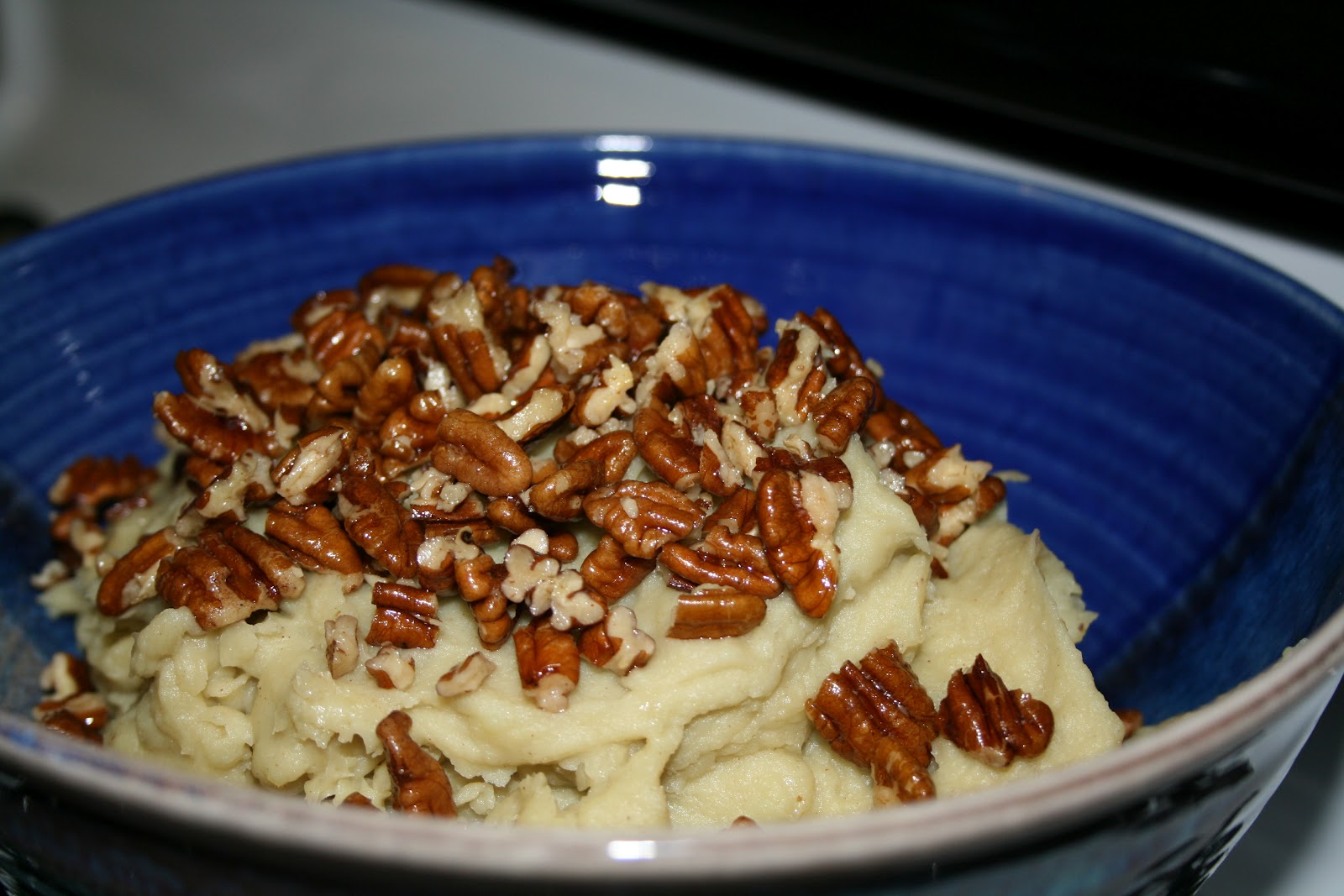
Coyote Joe's recipe for Bourbon Sweet Potatoes was a no-brainer. As he puts it in the description above the recipe, "Heavy cream, butter, bourbon, and brown sugar... it's simply heaven." Well, yeah! The Texan said his mom always puts a little bourbon in her sweet potatoes. I'd never even thought of it, so clearly I've missed something all these years. Oblivion aside, I thought boozy sweet potatoes with our buffalo steaks would be just the right spin on the typical meal, so I didn't skimp at all on the cream. Or butter. Or brown sugar. Or bourbon. The texture, blitzed to perfection in my trusty Cuisinart food processor, was indeed heavenly. The sauteed pecans on top were just the right contrast to the smoothness. Plus, Texans love pecans.

I used white-fleshed sweet potatoes, but you can use whichever kind you like.


Of course, if you eat steak and potatoes for dinner, you have to eat a green vegetable with it. Which is a lesson I learned from my mother.

Broccoli, steamed with a little butter, lemon juice, salt, and pepper.

West Texas Barbeque Rub
from On the Chile Trail

6 TBSP ancho or mild New Mexico chile powder
1 TBSP granulated sugar
3 TBSP brown sugar
3 TBSP kosher salt
2 TBSP  ground black pepper
1 TBSP cumin (I used about 1/2 tsp)
1 TBSP cayenne powder

Mix all ingredients in a small bowl or container. Rub (really RUB) spice mixture into meat on both sides, if applicable. If possible, let meat absorb spices for 8-12 hours in refrigerator before cooking. If not, let stand for 20-30 minutes before cooking. 


Bourbon Sweet Potatoes
serves 6
from On the Chile Trail

3 sweet potatoes, peeled and cut into 1-inch cubes
1/2 C chopped pecans
1 tsp butter
3 TBSP soft butter
4 TBSP firmly packed brown sugar
4 TBSP heavy cream
3 TBSP bourbon
1/4 tsp cinnamon
pinch of nutmeg
salt to taste (I didn't use any)

1. Boil sweet potatoes for 30 minutes, or until tender.
2. As sweet potatoes are cooking, saute pecans in 1 teaspoon of butter for 2 minutes.
3. Drain sweet potatoes and place in food processor while still warm. Add 3 tablespoons of butter and remaining ingredients (and salt, if desired). Puree, adding more cream if needed to achieve soft, creamy consistency. 
4. Top with sauteed pecans.

Sunday, February 19, 2012

I Heart You


The Texan and I celebrated our first Valentine's Day together this year. And while, as one of my friends pointed out roughly 27 times on Facebook, one should not save all gestures of love and affection for February 14th, The Texan planned a lovely surprise for me, so I figured I would cook him something heart-y in return.

 Ages ago, I cut out a recipe for Rosemary Shrimp Scampi Skewers from Cooking Light magazine (February, year unknown). The blurb that accompanies it says, "Rosemary has a long history of being associated with the heart: It has been believed by many to be a love charm, by others to be a token of remembrance and fidelity, and by some to be a potent aphrodisiac." So figuratively, this recipe was perfect for V-Day.

Literally speaking, it was also perfect: The Texan and I had fallen into the highly indulgent but not so healthy habit of eating out a zillion times a week. We agreed that our hearts (not to mention our wallets) would be better off if we cooked at home more. Plus, shrimp are a good source of omega-3 fatty acids, which can help reduce the risk of cardiovascular disease and stroke. Which is of course what everyone is thinking about on Valentine's Day.

Anyway, there just happens to be a rosemary bush in The Texan's backyard, so he snipped off a few sprigs a few minutes before we cooked the shrimp, which had been marinating in white wine, lemon juice, and a bit of olive oil with some spices. He threaded the shrimp onto the now-naked sprigs, which still smelled fantastic despite being totally bare, and because it's February and his girlfriend  would have spent the evening complaining about how cold she was, he fired up the stove top instead of the grill.

As the shrimp cooked in their marinade, I sauteed some asparagus spears in a bit of olive oil and a seasoning that had the words 'Texas', 'cowboy', and 'grill' on the bottle. I know! My eyebrows were raised, too! But it turned out well, and we ate every single piece. The Texan knows his way around a microwave, so he steamed up more veggies to round out the greenness on our plates, and dinner was on the table in under 30 minutes.


You couldn't give a rat's ass about omega-3s, marinades, or spice blends, though. What you are really wondering is, is rosemary actually an aphrodisiac?

I can't tell you that. My dad reads this blog.

Rosemary Shrimp Scampi Skewers
adapted from Cooking Light magazine

NOTE: I made at least double this quantity of marinade, both to cover all the shrimp and to have extra to use in the pan. 

1 TBSP dry white wine
1 tsp fresh lemon juice
1 tsp olive oil
1/8 tsp salt
1/8 tsp pepper
1 garlic clove, minced
3/4 lb shrimp (I used 1 pound of the 26-30 size), peeled and deveined
6-inch rosemary sprigs (number you will need depends on number of shrimp used)

1. Combine first 6 ingredients in a resealable bag or non-reactive bowl. Add shrimp, turning to coat. Marinate in refrigerator for 30 minutes, turning occasionally.
2. Remove leaves from rosemary sprigs, leaving about an inch of leaves at one end. If grilling, rinse/dip sprigs in water to prevent fire.
3. Load 3-4 shrimp onto each rosemary sprig. Carefully load onto preheated grill or saute pan, using marinade if desired. Cook 2-3 minutes per side, or until shrimp is pink and cooked through. 
Do NOT use uncooked marinade on cooked shrimp!

Tuesday, September 6, 2011

Bolinas Blackberry Pie

My mother used to read Blueberries for Sal to me before bed when I was small.  It was one of my favorite books, in part because eating my way through a bush of blueberries as Sal does seemed like a brilliant idea, and in part because the mother-child mix-up that happens is classic.


This Labor Day weekend, I drove out to rural Marin County to see my dad, and relieve him of some blackberries which grow [a little too] wild in his yard. He hacked at the brambles with a machete while my dog ran amok and I got lost (practically) picking berries. I imagine blackberry bushes are a little more violent than blueberry bushes, since Sal's hands and legs didn't look like mine when she, the bears, and her mom were done picking. Bear claws, though, are pretty near the top of the Potentially Damaging hierarchy.

Since I didn't have to compete with bears, I gathered about nine cups of blackberries. That doesn't include all the ones I ate as I picked, or the ones I dropped as my skin snagged on a thorn and I cursed the entire universe. I gave about a cup to my dad-- I wasn't being stingy. He didn't want more -- and took the rest home to bake in a pie.

I wound up tossing out about a cup of berries this morning, since some were just past their peak. Apparently, blackberries' peak lasts about 3 seconds. Others just got crushed from the weight of the other eight cups stacked on top of them. I froze about a cup to use in smoothies later, so used about six cups of berries in the pie.  I didn't have an official blackberry pie recipe to use, so I combined elements from a few different pie and fruit tart sources, and created what just might become an annual tradition.

For the crust, I used a recipe from Vegetarian Times I'd cut out ages ago but hadn't used yet. The ingredients are simple and the method is easy-- basically, everything is thrown in the food processor and pulsed until the dough comes together. I've already written an ode to the Food Processor (Wo)Man for this very thing; it turns out a perfect crust every time. My lattice was a little gangly and uneven, but for my first attempt, it was Not Bad At All.

For the filling, I started with brown sugar, and lots of it.  My dad and I both noticed that the berries were not as sweet as they've been in years past, which my dad attributes to the lack of warm sunny days this summer. I think it may also be that the brambles are being choked by the two other invasive vines spewing over from other people's yards. (Several blackberry species have also been deemed invasive here in California. Eh, potayto, potahto...) Property lines and semantics aside, I added a little cornstarch to thicken the soupy mess the berries were becoming, and a little lemon juice to brighten up the whole thing.  This is also what goes into the filling for the Rustic Fruit Tart I wrote about. Except with blackberries. Not plums.

I blind-baked the crust to prevent it from getting soggy from berry juice. The problem with this method is that the top edges of the crust brown long before all the rest of it, and sometimes even burn before the pie is ready. The logical solution would be to blind-bake it for less time, but then the bottom wouldn't be baked enough to stay, well, crusty. I might try covering the edges with extra parchment paper next time, with some kind of clamping or folding trick to make the paper stay in place over the edge.  

All things considered, the pie is perfect for the end of summer. It even has tan lines.   


Fine. I admit it. The crust recipe didn't make enough dough for crust AND lattice.


I know! I was a little worried about the whole machete/dog/me combination, too! But I made it out alive. And so did the dog.


Bolinas Blackberry Pie

*If you choose to create a lattice (or any other) design on top, you will need to a) make 1.25 times this amount of dough (use extra water instead of 1/4 egg); b) set aside a small quantity of the dough as you begin Step 5a.  This way, you will create extra dough for the lattice, and still have the original quantity for the crust. 
** Pre-bake times have been adjusted to account for my mistakes. You may need to add another minute or two onto your time.

For the crust
1 1/2 C all-purpose flour
1 TBSP sugar
1/2 tsp salt
1 stick (1/2 C) cold, unsalted butter, cut into chunks
1 egg yolk
1/4 C ice water

1. Pulse flour, sugar, and salt in food processor a few times to combine. Add butter, and pulse 5-6 times, or until mixture resembles coarse sand. 
2. Beat egg yolk and ice water in small bowl with fork. Add to flour mixture in food processor. Pulse just until dough comes together. 
3. Transfer dough to piece of waxed paper or plastic wrap. Press into a flat disk. Wrap tightly and refrigerate at least one hour (or overnight). 
4. Preheat the oven to 400 degrees. 
5a. On a well-floured surface, roll out dough into a circle approximately 1/4" thick and 14" in diameter for a 9" pie plate. Lay crust over pie plate, pressing lightly into bottom and sides. Create a fluted design, if you wish, around the edges by lightly pinching the overhang. 
5b. Also roll out dough reserved for lattice into rectangular shape, 1/4" thick and 11" wide. Cut rectangle into long strips. Set aside.
6. Place parchment paper over the crust (you can cut a circle to fit the bottom, or you can lay strips across the crust that overlap) and weigh down the paper with dried beans. Bake for 10 minutes. Remove beans and parchment paper and bake for another 5 minutes. Top of crust should be just beginning to brown.
7. Reduce heat to 350 degrees.

For the filling
6 C ripe blackberries, washed 
3 TBSP cornstarch
2/3 C brown or granulated sugar (adjust slightly according to sweetness of berries)
1 TBSP lemon juice
1/2 tsp grated lemon zest (optional)

1. Combine all ingredients in a large mixing bowl. Stir gently to combine, coating berries well.
2. Pour berry mixture into pre-baked pie crust. Arrange lattice strips on top.
3. Bake for 30 minutes, or until crust is golden brown and filling is bubbly. 
4. Cool on wire rack for as long as you can wait. 
5. Serve with a dollop of whipped cream or vanilla ice cream.


Wednesday, July 6, 2011

Green Things

I love love love the idea of growing one's own food, being a localvore, and reclaiming urban spaces for farming. In the past, though, my container gardens have died died died and I decided long ago to leave the growing to farmers. And hipsters.

Emboldened by my neighbor who has similar fantasies of lush green fire escapes, I am nurturing a few plants in containers once again. We decided to be particularly ambitious and start our garden from seeds.  We planted two varieties of tomato, some cilantro, two kinds of basil, three kinds of lettuce, and cheated only once by planting parsley that was already growing in a four-inch pot. A veritable salad growing right there on the fire escape.

The lettuce is dead. Truth be told, we killed it. On purpose. It became infested with aphids. The ol' soap n' water spray didn't help in the slightest. I thought aphids chewed holes in leaves. But they didn't. They just hung out. En masse.


The tomatoes are still alive. Sort of. A colleague showed up at work one day with several varieties of heirloom seedlings that were healthy-looking and much bigger than the ones I was becoming so proud of. Her housemate is a gardener at Filoli House, so I knew these were the Real McCoy. I wasn't sure if I wanted to cheat and plant these seedlings, but all doubt was erased when I noticed a flat of Cherokee Purples. OH. MY. GOD. It was, like, destiny. I ripped out all but one of the from-seed plants in the container, and planted the Cherokee Purples and an Arnie's Round. I hoped my neighbor wouldn't notice. She noticed.  


Survival of the fittest

The parsley has made a miraculous comeback from the brink of death. Not sure why or how, but I'm glad. I used several sprigs in the salad dressing I made this weekend-- an herb-anchovy-lemon juice concoction. The cilantro is getting rather leggy in the middle, so I keep cutting it back. No idea if that's the right thing to do or not. The basil has been culled ruthlessly. My neighbor planted many seeds in a little container, which we figured was a way to hedge our bets, so to speak. But the basil seedlings were crowded, we realized, so the dead are fertilizing the survivors in a Darwinian tribute to the cycle of life. I considered swapping out the seedlings for one of those very bushy and healthy-looking one-gallon pots of basil that taunt me each time I walk in to Trader Joe's, but my neighbor would definitely notice. 


A few weeks ago, we were at Berkeley Bowl, and saw some well-established-yet-still-young-enough-to-qualify-as-grown-by-us vegetable pots for sale. I grabbed a six-flat of yellow wax beans while my neighbor wasn't looking, and then saw the most irresistible plant ever bred: a chocolate bell pepper. The first pepper, of course, is practically ready to eat, though its tag says it will turn a lovely chocolate brown when it's really ready. But there's a new pepper coming along,
which will be all ours to take credit for on our very urban, third-floor, totally local fire escape. 


Beanie babies


The Holy Grail of vegetables

Sunday, April 10, 2011

R & R

I don't subscribe to Sunset magazine. A random copy of it arrived in my mailbox the other day anyway. Thumbing through it, I realized it was not the same magazine my mother used to subscribe to, with Michigan-ized enchilada recipes and how-to-build-your-own-deck instructions. Instead, I found a recipe developed by some organic farmer-restaurateur in Canada for Rhubarb Upside-Down Cake with Caramel-Rosemary Sauce.

Putting aside for a moment the fact that the title of this dessert is far too long, it occurred to me that rosemary, cream, and sugar just might work drizzled over a cake with fruit on top. Or on bottom. Hard to say with an upside-down cake. Regardless of direction, I got started. An acquaintance has a lovely rosemary bush growing in his yard; he donated a healthy sprig to this endeavor. Green & Black's makes the best white chocolate bar I've ever had (let's face it, white chocolate doesn't excite anyone); it imparted a lovely vanilla flavor to the cake.  Berkeley Bowl, of course, supplied the rhubarb.


The cake was perfectly edible on its own. The flavor and texture were pleasing, and the tart rhubarb is always a nice contrast to anything sweet. But the sauce... oh, the sauce! Cream, infused with rosemary, gets stirred into caramelized sugar with a touch of lemon juice. First the sweetness hits the taste buds, and then the rosemary, yet the rosemary is anything but an afterthought. After the cake was gone-- I had help eating it, I swear-- I found excuses to dip a spoon into the remaining sauce: my smoothie needed a boost, my coffee wasn't sweet enough (whoa-- not delicious), my tongue needed some rosemary cream sauce, etc...  I love that rosemary, usually an herb reserved for savory dishes, is featured so prominently in this dessert, and it works. 

Truthfully, I omitted half the recipe: the cake is also supposed to have a warm rhubarb compote poured over it, alongside the rosemary caramel sauce. Next to all that should be a scoop of Sour Cream Chamomile Ice Cream. Handmade, of course, featuring chamomile I grow myself. I admit I am curious about the ice cream. But in addition to this dessert's title becoming Rhubarb Upside-Down Cake with Rosemary-Caramel Sauce and Warm Rhubarb Compote Accompanied by Sour Cream Chamomile Ice Cream, its being also becomes too complicated. The unexpectedness of the rosemary is the limit for one dessert. More herbs, flavors, and sauces would just make it garish.

I suppose that's the trouble with getting pretentious-- it's hard to know when enough is enough.

Rhubarb Upside-Down Cake with Rosemary-Caramel Sauce
(adapted from Sunset magazine, April 2011)
Cake
1/2 lb rhubarb, cut into 1/2-in slices (2 cups)
1/2 C + 3 TBSP granulated sugar
3 oz white chocolate, chopped
1/3 C unsalted butter, room temperature
2 egg whites, room temperature
3/4 tsp vanilla extract
1 1/3 C cake flour 
2 tsp baking powder
1/2 tsp salt
1/2 C milk

Sauce **
1 C whipping cream
1 rosemary sprig
1 C granulated sugar
1/2 tsp lemon juice

1. Preheat oven to 350 degrees. Butter or spray a 9-in round cake pan (or 8 one-cup ramekins). [Optional: line pans with parchment paper cut to fit bottom. Butter/spray paper.] 
2. In a bowl, toss rhubarb with 3 tsp granulated sugar. Spoon evenly into pan or ramekins.
3. Melt white chocolate in a double boiler. Whisk until smooth, 2-4 minutes. Let cool.
4. Beat butter and 1/2 C sugar in a bowl until fluffy. Add egg whites and vanilla. Beat until well-blended. 
5. Combine flour, baking powder, and salt in another bowl. Beat flour mixture into egg mixture alternately with milk (half at a time), until smooth. Stir in chocolate. 
6. Spread batter evenly over rhubarb. Bake until golden brown and a toothpick inserted in the center comes out almost clean (28-35 minutes). Let cool in pan. 
7. Meanwhile, heat cream and rosemary in small saucepan over medium heat until bubbles form at edge of pan, stirring occasionally, about 3-5 minutes. Remove from heat. Discard rosemary. 
8. Stir granulated sugar with lemon juice and 2 TBSP water in a 12-in frying pan. Cook over medium-high heat, occasionally swirling mixture around sides to wash down sugar crystals, until deep golden, 5-6 minutes. Immediately remove pan from heat, add cream (it will bubble up), and whisk until smooth. Transfer to serving bowl.
9. Loosen cake from pan/ramekins. Invert over serving plate(s). Remove paper, if used. Spoon a bit of sauce over slices, and serve. 

 ** My sauce turned out more custardy than caramely. This is probably due to my impatience with all things sweet. To achieve a more golden sticky caramel sauce, one must follow the recipe.

Saturday, January 29, 2011

Winter Blahs?

Winter is not my favorite season.  Or my second favorite.  Or my third. Grays and browns dominate the winter landscape in Chicago, where I spent 3 very long winters.  It's ugly.  It's cold. It's gloomy and depressing.  And while I don't live there anymore, I find the bright colors of vegetables from the farmers' market just as cheery as I did when I bought them in Chicago in January. Oh no, wait-- there is no farmers' market there in January.  Because farmers can't grow vegetables in the Arctic Tundra.

I've gotten spoiled living here in California, what with its year-round growing season and truly amazing variety of produce.  But even I was surprised by the glowing jewels of color that made their way into my bag last weekend.  When people speak of winter produce, the image of row after row of Swiss chard pops into my head, with little room for anything else.  While there were plenty of greens in my bag, there were also greens that weren't green, balls and sticks of orange, and marbles of magenta. 


The radish practically glows pink


I wouldn't want to live anywhere else.

Wednesday, November 10, 2010

Slices of Quince

"They dined on mince, and slices of quince,
Which they ate with a runcible spoon;
And hand in hand, on the edge of the sand,
They danced by the light of the moon..."
                                      -Edward Lear, "The Owl and the Pussycat"

 I don't have any runcible spoons, which until now has been a non-issue because I've never had quince either. This is probably because I don't live in Roman times, when lovers were said to give each other quince as a pledge of fidelity.  Or perhaps it's because quince is a little high-maintenance: it needs to be sweetened before it can be eaten, since the raw fruit is sour.  Most likely, though, it's because my trusty food magazine has never run an article on it before, tempting me to try it.


I let the fruit sit for a few days in the fruit bowl to let it ripen a bit more, and noticed that the fruit gives off a very sweet scent, which reminded me of the bubble bath my mother used to put in the water when I was little.  I doubt it was intentionally quince-scented, but you never can tell...

 I precooked the quince slices in water with some agave syrup and cinnamon for about 10 minutes.  This softened and sweetened them, making them perfect for the winter crisp recipe I found in a random stack of recipes culled from godknowswhere.  I added a little more agave to the baking dish, tossed in the slices with a few spoonfuls of the cooking water, and topped it with an oat mixture. 


Now all I need is a Roman lover.


Quince Crisp
*note: I cut this recipe in half, since I used only 2 quince. 

Filling:
1/2 C sugar (use less if you toss the slices in agave)
3 TBSP all-purpose flour
5 C quince, sliced (leave peel on)
up to 1/4 C reserved cooking water


Topping:
3/4 C rolled oats
1/3 C brown sugar
1/4 C whole-wheat flour
2 TBSP gr. cinnamon
1 tsp gr. allspice
1/2 tsp gr. ginger 
2-3 TBSP butter, melted

1.  Preheat oven to 375 degrees.

2. Combine filling ingredients, mixing well to coat.  Spoon into 6-cup baking dish, and add enough cooking liquid to keep the fruit moist and a little syrup-y but not soggy.
3. In a small bowl, combine dry topping ingredients and mix well.  Add melted butter, one tablespoon at a time, until mixture is coated and forms small lumps. 
4. Sprinkle topping over filling, and bake for 16-20 minutes, or until filling is bubbly and top is nicely browned.

Monday, November 1, 2010

Turning into a Pumpkin

When I was little, I ate Swiss cheese like it was going out of style. My parents used to tell me I'd turn into Swiss cheese if I ate any more.  That didn't happen.  However, I did become lactose intolerant at adulthood, which was probably Swiss cheese's sweet revenge.

This fall, I am eating and reading about pumpkin like it's going out of style (and yes Dad, I know that's a grammatical faux pas but saying "as though it were going out of style" is just so awkward).  This weekend I came across recipes for pumpkin cake, pumpkin bread, pumpkin pudding (which turned out to be more like pumpkin frittata), pumpkin cornbread, and even pumpkin lasagne. That last one sounds a little sketchy to me.  But no matter-- there are plenty of delicious pumpkin recipes to satisfy my pumpkin-eating soul, such as the Maple Pumpkin Spice Bread I made on Sunday.

Little Orphan Annie and her trusty dog Sandy (also handmade)
Halloween has always been my favorite holiday.  My mother insisted this was the influence of my Celtic heritage. It could just as easily have been the combination of my birthday 2 weeks before, the handmade costumes my mother always made for me,
 the smell of singed pumpkin flesh permeating the air, and THE CANDY.  As anyone who has come within 50 yards of me knows, I am drawn magnetically to anything with sugar. Either way, I get all pumpkined out around Halloween: my friend Christy sends me pumpkin-themed gifts from all over the world, I stock up on canned organic pumpkin at Trader Joe's, and giant pumpkins appear out of nowhere.


While I am sad that I no longer get to trick-or-treat*, I am happy to have discovered how versatile my beloved pumpkins really are.  I roast them and throw them in a pan with a little sausage or bacon and some greens. I bake sweets with them.  I make smoothies with them.  I feed them to my cats.  Yeah, virtually all cats love pumpkin.  Evolutionarily speaking, though, what are the chances of a big cat encountering, let alone cracking open and eating, a pumpkin?

*One of many trick-or-treat memories is me coming home with my little plastic pumpkin filled with candy, and my older brother coming home with a friggin' pillowcase full of candy.  He made sure to point out how much more candy he got.  A day or two later, I figured out his secret candy hiding place.  After that, our piles were even-steven.

Maple Pumpkin Spice Bread
adapted from Vegetarian Times, November 2009
*While the recipe calls for a cup of maple syrup, I used agave syrup with a tablespoon or two of evaporated can juice instead.  It's less than half the price of maple syrup, and agave is low on the glycemic index.
1 C whole wheat flour
1 C all-purpose flour
1 TBSP gr. cinnamon
2 tsp gr. ginger
1/2 tsp gr. allspice
1/2 tsp gr. nutmeg (I used less than 1/4 tsp)
1 1/2 tsp baking powder
1/2 tsp baking soda
1 C maple or agave syrup
1 C pumpkin puree
1/2 C canola oil
2 eggs
1/2 C chopped hazelnuts
1 tsp vanilla extract


1. Preheat oven to 350 degrees. Coat a 9x5 loaf pan with cooking spray. 
2. Whisk together flours, spices, baking soda, and baking powder in a large bowl.
3. Whisk together syrup and oil in a separate bowl. Whisk in eggs, and then pumpkin and vanilla.  Stir flour mixture into pumpkin mixture with a spatula, mixing only until combined.  Add hazelnuts. 
4. Pour into prepared pan and bake for 40-50** minutes, or until toothpick inserted in center comes out clean. Cool on rack 5-10 minutes, and then remove from pan to cool completely. 
5. Slice and top with a little bit of pumpkin cream cheese from Trader Joe's.  Wait, that's not in the recipe...

** My oven is temperamental and I usually have to bake desserts for less than the recommended time, at a slightly lower temperature than indicated.  However, this bread needed extra time in the oven, and the very edge got a little black.  It has not affected the flavor, but know that
it will be important to check the center with a toothpick regularly.
I  made a few muffins with this batter, since my pan is smaller than 9x5, which could also affect baking time.

Not burned. And a cute muffin to boot.


I heart Trader Joe's.

Sunday, October 3, 2010

A Rose by Any Other Name


I've laughed out loud in the produce section lately. While Berkeley is filled with people who talk to themselves or laugh at silent, invisible jokes, I had rather hoped I wouldn't be one of them.  Anyway, it seems funny food names favor fruits disproportionately.  Obviously, vegetable growers lack a sense of humor. 

Recently I've eaten foods called:
-'Hippy Zebra' (a green striped tomato)
-'Beef Master' (only a man would come up with this)
-'Jolly' (I pop these in my mouth whole.  Is that piggish?  So?)
-'Mortgage Lifter' (who cares what they look like? I'm buying these by the truckful)
-'Torpedo' (a red onion in the shape of... a torpedo)
-'Elephant Heart' (a blood-red plum with an odd shape)
-'October Sun' (I'm totally biased here)
-'Ruby Velvet'(aptly named, but plum people clearly have too much time on their hands)
-'Emerald Beaut' (sic) (ditto)
-easter egg radishes (red, pink, purple and white all in one bunch)
-lemon cucumbers (these are the cutest cucumbers EVER invented)
-rainbow chard (I wish the color didn't fade when I cook it)
-dinosaur kale (you can't NOT eat this stuff!)

I've probably fallen for the oldest marketing trick in the book-- make the product sound enticing and people will buy it.  But hey, I'd rather buy 'Elephant Heart' plums than 'Red Misshapen' ones.

Friday, September 17, 2010

Localvore

About a month ago, a friend handed me a bag with 4 unripe avocados in it.  I had no idea what I was supposed to do with them.  We were going to Santa Cruz with her family, so I wondered if I would be forced to eat hard green avocados on the beach, Filipina-style.  I doubt that's really Filipina-style, but whatever.

It turns out they were from one of the avocado trees in her backyard, which her husband planted and tends lovingly.  I waited patiently for the avocados to ripen, and gave one to my dad since I knew a) he'd like it; b) all four would ripen at once and I'd be avocadoed out. I put one in a bag to speed it along, but heeded the advice of my friend's husband: "If you think it's ready, wait one more day."  When it was finally ripe-plus-one-day, I cut open the freshest, perfectest, most deliciousest avocado I've ever had.


I stood in the kitchen, tasting small bites of the fruit, while trying to decide what to make with it.  I considered making guacamole, but figured that was just so expected.  I thought about adding it to burritos, but didn't feel like preparing all the ingredients.  I remembered the salads we had several nights a week with dinner when I was a kid, and how I'd always steal pieces of avocado off the top while my parents put the finishing touches on the rest of the meal.  But I wasn't really in the mood for salad this night.

By the time I contemplated and rejected several dinner options, I had only a quarter of an avocado left.  It was clear that there was only one thing left to do: polish off the rest!


Leilani and Gary, I can't wait for more avocados!

Oh, and it turns out that Filipina-style avocado eating involves cutting up the avocado and adding sugar and milk.  Hmmm...